
Last updated
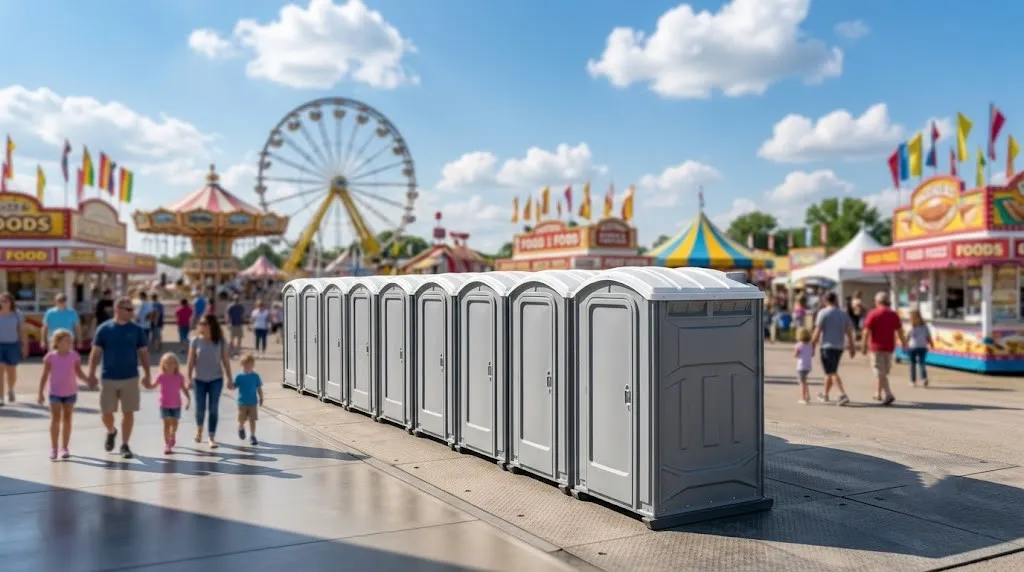
How many restrooms does a county fair need in Alexandria?
Staff sanitation and public sanitation are two different math problems. OSHA 1926.51(c)(1) sets the crew-side ratio: one toilet facility for 20 workers or fewer, then one toilet seat and one urinal per 40 workers as staff climbs past that. That rule covers your vendors, ride operators and grounds crew. It does not cover fairgoers, and a lot of first-time organizers miss that split entirely.
Public-facing counts run heavier because bathroom visits cluster around meal breaks, headline acts and the hour before gates close. Alexandria Porta Pros sizes fair jobs off expected peak attendance, not average attendance, because a fair that's quiet at 11am and packed at 2pm still needs enough stalls at 2pm. Our porta potty placement guide walks through the ratio in more detail, and the how many porta potties do I need page has a fuller breakdown by crowd size.
Every cluster of standard units also needs an accessible stall. ADA Standards section 213.2 requires at least 5 percent of clustered single-user units to be accessible, never fewer than one. We stock ADA accessible porta potty units with a 60 inch turning circle inside, per ADA 304.3.1, and a 32 inch clear door opening under ADA 404.2.3. If your fair layout has multiple restroom banks scattered across the grounds, each bank needs its own accessible unit, not one for the whole fairgrounds.
What restroom options work best for a county fair?
Standard units cover the bulk of a fair crowd and this is where most of the budget goes. A standard porta potty rental runs a 60 to 70 gallon holding tank and stands about 92 inches tall on a 44 by 48 inch footprint, small enough to line up along a fence row or midway edge without eating into vendor space. For multi-day fairs, rental math shifts from a daily rate to an event rate, and that's worth checking on our porta potty rental cost page before you commit to a headcount.
Fairs with a VIP area, judges' tent or sponsor hospitality zone usually add a step up from standard. A deluxe flushable porta potty gives that crowd a flush toilet and a sink instead of a hand sanitizer pump. For a larger hospitality footprint, a restroom trailer rental or 2 stall restroom trailer handles a steadier line without feeling like a construction site. Larger county fairs with grandstand seating often step up to a 4 stall restroom trailer near the main stage.
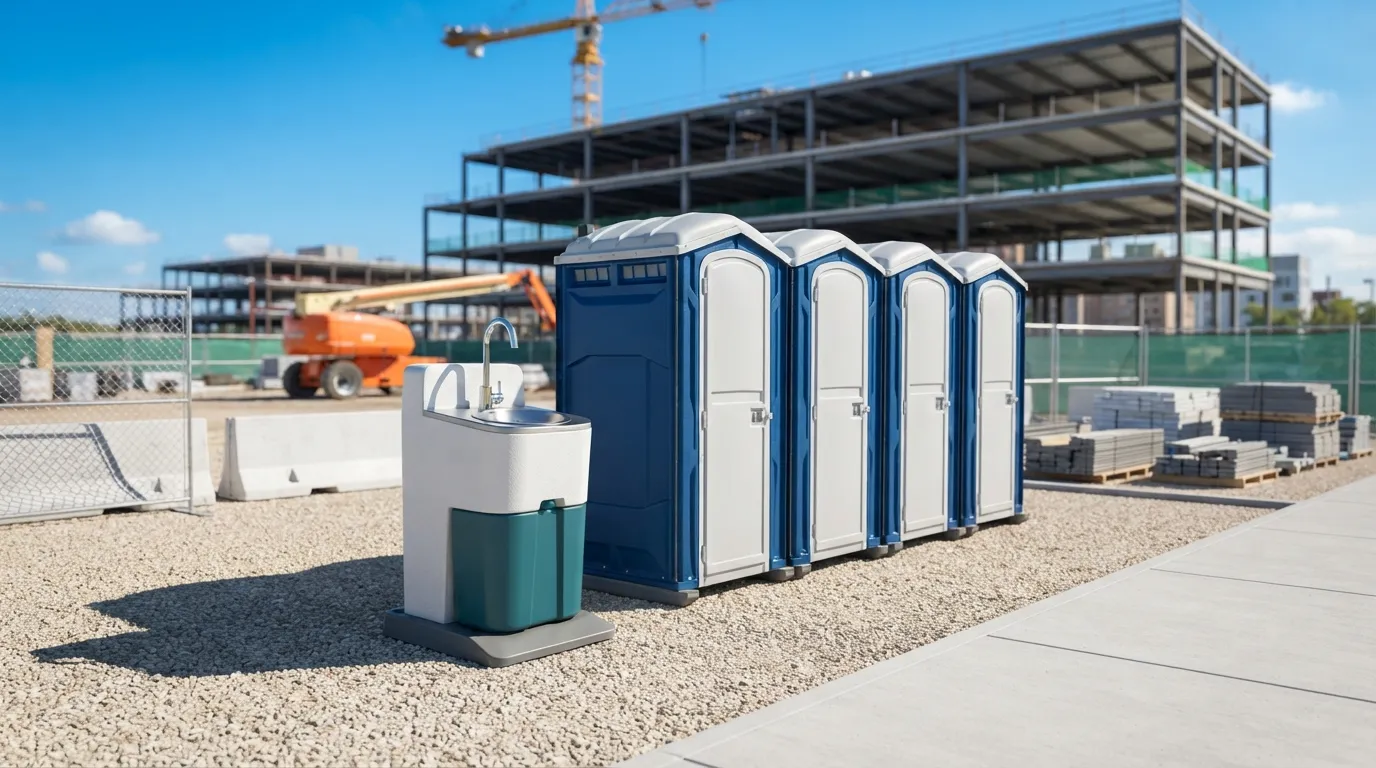
Livestock barns and 4-H areas bring their own sanitation load, especially with hand-labor volunteers on site for judging and mucking. That crowd benefits from a handwashing station rental placed right at the barn entrance, separate from the toilet cluster, since 29 CFR 1910.141(d)(2) requires soap and towels or a hand-drying device at wash stations, not sanitizer alone. If your fair includes a livestock or crop competition, our farm and agricultural restrooms page covers layout specific to that setup.
Where do restrooms go on a fairground layout?
Placement decides whether restrooms actually get used or just get complained about. Every unit needs a stable, slip-resistant surface under ADA Standards 302.1, which rules out loose gravel or soft turf on wet fairground soil. Alexandria sits close enough to several fair-hosting towns that we deliver across the corridor: Arlington is 5.4 miles north, Bailey's Crossroads sits 4.4 miles northwest, and Belle Haven is 5.4 miles southeast, so grounds near any of those spots are within normal delivery range.
A roll-off truck needs about 60 feet of straight clearance behind it to drop a unit safely, which matters if your fairgrounds route delivery trucks through a narrow gate or between vendor rows. Walk that path before delivery day. Placement also needs to respect the public right of way if any restrooms sit near a street frontage; that placement needs confirming with the City of Alexandria before setup, since we haven't verified a specific ordinance for this page. For general placement logic, our porta potty rental checklist and porta potty permit requirements pages are a good starting point.
Multi-day fairs also need a service plan, not just a delivery. ANSI/PSAI Z4.3 sets a baseline of one service visit per week for up to 10 users over a standard 40 hour week, but a three-day fair with thousands of visitors needs same-day or next-day servicing instead, timed around evening close rather than a weekly cycle. Ask about that schedule when you request a quote.
How far in advance should I book restrooms for a county fair?
Book as soon as your date and attendance estimate are set, ideally 4 to 8 weeks out. Fair season overlaps with weddings and festivals across the region, and trailer units especially book out fast. Early booking also gives time to finalize ADA counts and barn-area handwashing needs.
Do county fairs need accessible restrooms?
Yes. ADA Standards section 213.2 requires at least 5 percent of any cluster of single-user units to be wheelchair accessible, with a minimum of one no matter how small the cluster. Fairs with multiple restroom banks need an accessible unit at each bank, not just one for the whole event.
How many days can restrooms stay on site for a multi-day fair?
As long as the fair runs, plus setup and teardown days if needed. Multi-day pricing runs by the week rather than stacking daily rates, which is usually cheaper for a 3 to 5 day fair. Check the porta potty rental per day and weekly comparisons before booking.
What's the difference between standard and deluxe units for a fair?
Standard units are stall-only with a 60 to 70 gallon tank, suited to general midway traffic. Deluxe units add a flush toilet and sink, better for VIP tents, judges' areas or sponsor hospitality where guests expect more than a basic stall.
Do livestock barns need separate handwashing stations?
Yes, and it should sit apart from the general toilet cluster. Volunteers and exhibitors handling animals need soap and towel-based handwashing under 29 CFR 1910.141(d)(2), placed right at the barn entrance rather than shared with fairgoer restroom lines.
Next step
Get a delivery date
Tell us the address, the dates and the headcount. We size the order and confirm the route.